

When the State Demands Your Contracts: BSI Belize, Corporate Privacy, and the Unfinished Architecture of Kenyan Information Rights
Issue 002 — A Comparative Analysis by Gody Mwango
On 29th February 2024, the High Court of Belize [“the Court”] (Goonetilleke J.) delivered the judgement in Belize Sugar Industries Ltd & Corozal Sugar Cane Producers Association v Attorney General of Belize (CV 322 of 2023), which struck down a set of sugar export regulations that required Belize Sugar Industries Limited (BSI), the dominant sugar mill in the country, to disclose all its commercial contracts with international buyers as a condition of licensing. The regulations required a mandatory collection and distribution of Fairtrade premiums to local farmers or risk immediate licence revocation. The Court found that regulations 5(1)(b), 5(2), 16, 21(1)(b) and 22 of the Sugar Industry (License to Import/Export Sugar) Regulations 2023 were unconstitutional, specifically because they violated the right to work, the right to protection of the law and the right to privacy under the Belize Constitution. The facts are straightforward, but the doctrinal implications are far-reaching: a sugar exporter challenged the power of the State to compel disclosure of its private commercial contracts and to impose mandatory collection obligations dependent on a foreign buyer (Tate & Lyle Sugars, incorporated in the UK) that had expressly refused to cooperate. The court agreed on both issues.

For Kenyan practitioners, the judgment is highly relevant because it addresses a fundamental constitutional question, which three Superior Court decisions in Famy Care Limited v Public Procurement Administrative Review Board & others (Petition No. 43 of 2012), Nairobi Law Monthly Company Ltd v Kenya Electricity Generating Company & others (Petition 278 of 2011), and Kenya Legal and Ethical Issues Network (KELIN) v Cabinet Secretary, Ministry of Health & AG (Petition E063 of 2021), have examined from only one direction. All three Kenyan cases ask the question: whether a corporate body may obtain information from the State. Up until this point, no Kenyan court has confronted the mirror-image question: whether a corporate body enjoys a constitutional right to resist State compulsion to disclose its own private commercial information, and whether a regulation that makes the impossible mandatory is unconstitutional on its face rather than merely judicially reviewable.
The BSI Belize judgement resoundingly answers both, and it does so by deploying analytical tools which need not be transplanted into Kenya, as they are already available, though unutilised. While not binding on Kenyan courts, the BSI Belize judgement offers a greater comparative value, especially considering that Belize and Kenya enjoy a shared heritage as former British colonies, which inherited and still retain English common law roots and a shared parliamentary framework.
The Kenyan Trajectory: From Hard Exclusion to Statutory Codification
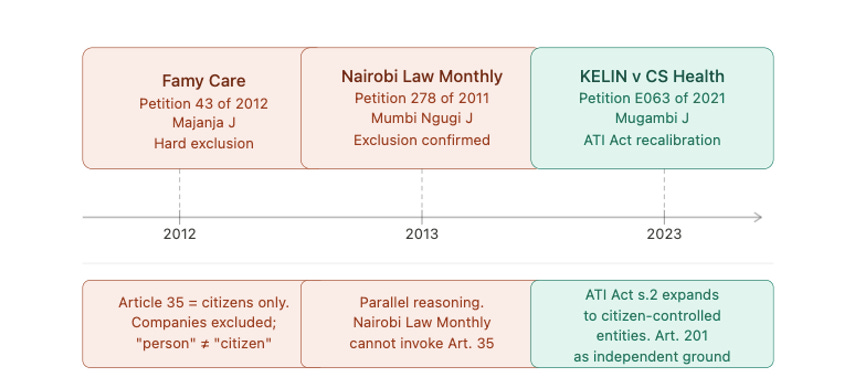
The Kenyan journey commences with two restrictive judgements. In Famy Care, Majanja J was confronted with the Constitution’s Article 35(1) question by an Indian company seeking tender evaluation records from KEMSA. The respondents raised a preliminary objection, arguing that only “citizens” have the right of access to information, and a company is not a citizen, strictly speaking. The court’s ruling reiterated that Article 35(1) is textually limited to citizens, unlike other rights framed around “every person” or “all persons.” [18]. Yes, Article 260 defines “person” to include companies, preserving Bill of Rights rights for juristic persons “to the extent that the right or fundamental freedom itself permits” [21]. Nevertheless, the court ruled that under the Constitution’s Chapter Three, citizenship is founded on birth, descent, registration, and marriage, attributes which are structurally incompatible with corporate existence. A juridical person is neither born nor married. Bearing this in mind, the court was unequivocal that Article 35(1) was unavailable to Famy Care.
The court sitting in the Nairobi Law Monthly v KenGen case arrived at the same conclusion based on facts which were materially identical to Famy Care. While citing Famy Care with approval, Mumbi Ngugi J noted that “the term “citizen” denotes a natural person who is a Kenyan citizen; a body corporate cannot claim corporate Kenyan citizenship irrespective of its ownership structure” [81–82]. This was a dangerously vague finding as the CIPIT Strathmore blog observed contemporaneously, for the reason that it threatened downstream consequences well beyond information rights. For instance, if corporate “personhood” is confined to human-attribute-specific rights, it potentially undermines corporate authorship under the Copyright Act. More specifically, the Copyright Act uses the words “author” and “person” in sections 2(1) and 23(2), which provisions heavily depend on precisely the kind of purposive extension that the citizenship cases were closing off. On the whole, the concern by CIPIT was more structural: courts were using a narrowed interpretative prism for the distinction between citizen and person, which portended broader suppressive implications for the participation of corporate bodies in rights-based frameworks.
Both cases were determined prior to the enactment of the Access to Information Act, No. 31 of 2016 (hereafter “ATI Act”, for short). Section 2 of the ATI Act defines citizen as “any individual who has Kenyan Citizenship, and any private entity that is controlled by one or more Kenyan citizens.” In effect, the Act addressed the gap inherent in the constitution by extrapolating the information access right to juristic persons, which are citizen-controlled, as a legislative redefinition. The concern was whether courts would embrace it.
They did. In KELIN, the petitioner, a Kenyan-registered NGO, sought clarity on whether the NGO Act’s duly registered entity could seek relief for rights violations under the Constitution’s Article 35. Before Mugambi J, the 1st respondent urged that the pre-ATI Act stance as per Nairobi Law Monthly v KenGen justifiably foreclosed corporate petitioners. The court rejected this invitation, ruling that the ATI Act had instead “enlarged the scope of persons that can seek information by expanding the category to include juristic persons under Section 2” [66-67]. Therefore, the petitioner, KELIN, being a Kenyan citizen-controlled corporate entity, qualified, hence dismissing the “busybody” claim by the respondent [65]. In closing, the court ruled that the petition “raised matters of great public interest, concerning the alleged misappropriation of GAVI donor funds amounting to USD 1.6 million that the Ministry of Health had agreed to reimburse using public money, and any person could bring such a petition under Articles 22 and 258 of the Constitution” [9-11].
The second notable doctrinal contribution of the KELIN case was that it tied Article 35 to the Constitution’s Article 201. Mugambi J ruled that as the matter related to information sought concerning public funds and their usage, the principles of public finance under Article 201(a) (openness and accountability) and 201(d) (prudent and responsible use of public money) operated as an independent constitutional multiplier on the disclosure obligation [105–109]. Failure to avail information regarding the funds’ usage or actions against those responsible “breached not only Article 35 but also Article 201(a)” [107-109]. The petitioner’s prayers were granted.
The Doctrinal Gap in the Kenyan Cases, and What BSI Belize Fills
Collectively, Famy Care, Nairobi Law Monthly, and KELIN establish three things and leave three things open. What they establish are these: a foreign-incorporated entity does not enjoy the Article 35 right [Famy Care [26]]; a juristic entity which is controlled by citizens enjoys Article 35 protection through the expanded scope of the ATI Act [KELIN [67]]; and in instances where information sought concerns State organ held public funds or their usage, Article 201 self-executes an independent constitutional duty of disclosure which further reinforces Article 35 [KELIN [109]]. Here is what the cases, as read together, do not tackle: whether a company enjoys a positive constitutional right to resist compelled disclosure of its own private commercial information; whether Article 201 transcends the context of public funds into other arrangements which are purely private commercial; and, lastly, whether a regulatory instrument imposing mandatory impossible obligations is unconstitutional on its face or merely a subject of judicial review. On all three, BSI Belize speaks directly.
First, regarding the privacy of corporate information, Goonetilleke J ruled that the terminology “person” as found in the privacy provisions of Belize’s Constitution “would include a legal person or a legal entity” [70]. The court adopted a privacy taxonomy made up of three limbs, as formulated in KS Puttaswamy v Union of India (Writ Petition No. 494 of 2012) via Julian Robinson v AG of Jamaica [2019] JMFC Full 04: (a) bodily integrity, (b) informational privacy, and (c) choice privacy [75-76]. Crucially, the court disaggregated the limbs, arguing that the first limb was unavailable for corporate bodies as the attributes such as bodily integrity and human dignity are preserved for natural persons only [78-80]. However, it was “farcical” to arrive at the conclusion that the lack of human dignity automatically extinguishes companies’ informational privacy rights. The court ruled that indeed “privacy is at the core of the operations of commercial entities” [79]. For this reason, confidentiality of commercial contracts is vital because of the potential competition detriment that arises from disclosure. Therefore, the court concluded that “Corporates do have a right to informational privacy no less than the individual” [80].
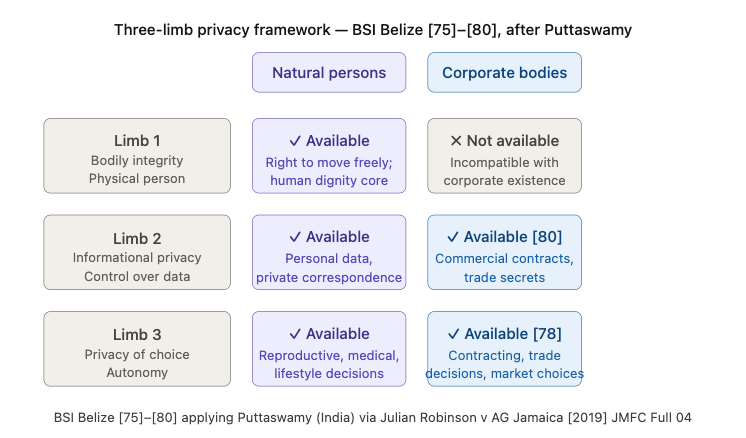
Juxtaposed, this trajectory of reasoning is available under Article 31 of the Constitution of Kenya, which protects “every person” and not just “every citizen.” Examined together with the definition of “person” under Article 260, which arguably includes companies, and the position under Article 20(2) that every person shall enjoy rights “to the greatest extent consistent with the nature of the right or fundamental freedom,” the three-limb approach in BSI Belize offers an immediate answer to the question Famy Care [21] grappled with but left unanswered. The bottom line is: Informational privacy in commercial contracts is simply compatible with corporate existence, specifically because it requires no human attribute to explain it. The Puttaswamy / Julian Robinson taxonomy cited with approval in BSI Belize is already cited in Kenyan jurisprudence, providing the analytical toolkit to directly say so.
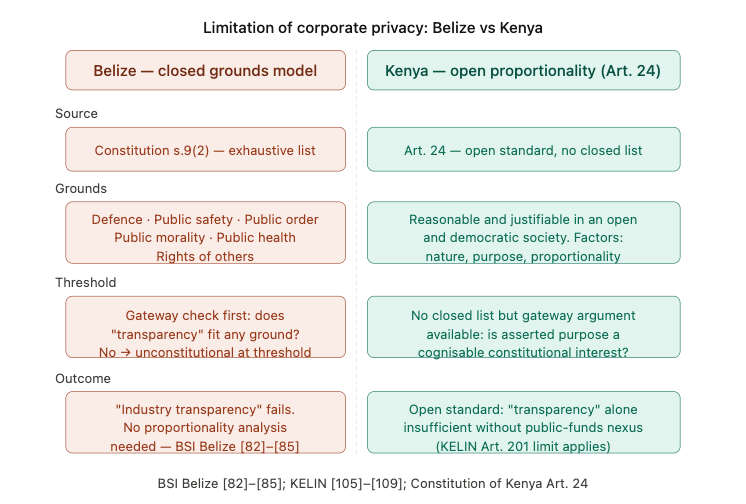
In relation to the scope of Article 201, the ruling in KELIN explained an important limit, which is supported from the other direction by BSI Belize. The justification of the government for compelling private contracts’ disclosure by BSI included Fairtrade premium distribution transparency and accountability between commercial parties in the sugar industry [82]. The court held that “disturbance to the sugar industry… or anxiety of a section of the farmers and their associations” does not fall within the constitutionally permissible grounds for limiting privacy [82-83]. This effectively means that the list of permissible limitations under the Belize Constitution is closed. Contrarily, Article 24 of Kenya’s Constitution is wide open, stating that any limitation must be “reasonable and justifiable in an open and democratic society.” In KELIN, the court found that the disclosure runs through Article 201 specifically, and Article 201 relates to public funds and not private commercial arrangements. In an instance where a State organ compels a private firm’s contractual disclosure regarding its engagement with private international buyers, neither Article 201 nor the public interest values in Article 10 offer sufficient justification for Article 24 by themselves. These aspects considerably heighten the burden of limitation, and neither “industry regulation” nor “transparency” provides sufficient answers.
Relating to the impossibility of regulation, the analysis of Regulation 16 in BSI Belize offers the most benefits to Kenyan regulatory litigators. At its core, the regulation was impugned for requiring BSI to “collect all proceeds, premiums or other benefits” from certified sugar buyers and distribute them to producers, with non-compliance attracting automatic revocation of the licence as the sanction [94–95]. In BSI Belize, the payer of the Fairtrade premium was Tate & Lyle Sugars, a foreign company that had expressly, in writing, refused to adopt the conveyor model and which was beyond Belizean jurisdiction [95], [106]. The court ruled that the word “shall” as used in Regulation 16(1) was imperative under the Interpretation Act of Belize [108]. Consequently, the court declined to read “shall” as “shall where possible”, arguing that courts are not at liberty to insert language that is not there [119]. The constitutional violation was therefore imminent: a regulation creating an obligation that is mandatory, whose performance is premised on a third party that is extraterritorial and a severe sanction that was automatic. In resting, the court characterized the breach as an infringement of the right to protection of the law as the regulation was irrational and unreasonable [116] and a violation of the right to work through its disproportionate measures [118]. The proportionality test failed primarily because the automatic sanction applied “irrespective of whether the licensee could or could not collect the benefits or premiums” [120].
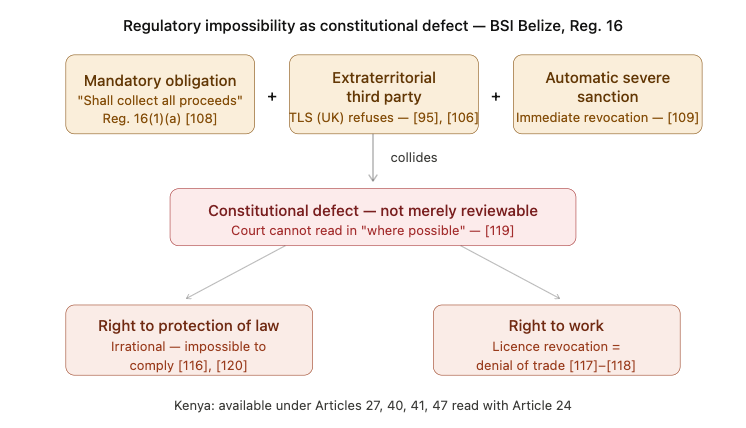
Until now, no Kenyan court has found a regulation unconstitutional for impossible mandatory obligations. Traditionally, the Wednesbury unreasonableness judicial review approach has been deployed, but it inconclusively remedies violations of substantive rights. For Kenyan advocates, the constitutional argument runs through Article 40, which deals with the protection of the right to engage in economic activity, Article 41 on fair labour practices, and Article 47 on fair administrative action, as read with the proportionality standard contained in Article 24. Here is the argument: a licensing or regulatory instrument that imposes a mandatory obligation whose performance depends on a third party or extraterritorial actor through compulsion by the State, supported by automatic severe sanctions such as forfeiture, licence revocation, or deregistration, is not merely a subject of judicial review. Instead, such a regulation is disproportionate at face value, as no extent of compliance by the licensee can avert the sanctions. The argument is directly applicable in Kenya’s agricultural export, capital markets, pharmaceutical and energy sectors, all of which impose compliance obligations with foreign certification bodies, international standard-setters, or cross-border payment systems.
Conclusion
The Kenyan path illustrates an arc from a regime that is more restrictive to a statutory codification of information rights, although this trajectory is faulty for leaving the constitutional weaving of corporate rights incomplete on one critical angle: the protection of information held by corporate entities from disclosure compulsion by the State. KELIN closes that doctrinal gap partly, specifically by confirming that corporate entities controlled by Kenyan citizens can access public information and that Article 201 multiplies the disclosure duty where public funds are in play. However, it fails to vest corporate privacy as a positive right, insufficiently highlights the limitation analysis applicable to compelled commercial disclosure in purely private contexts, or the constitutionality of impossible mandatory regulatory obligations.
BSI Belize speaks directly to all three. It embraces the Puttaswamy three-limb framework for corporate informational privacy, which is directly relevant and available under Article 31, Article 260, and Article 20(2) of the Constitution of Kenya. Its analysis asks a fundamental question: whether the justification for compulsion by the State amounts to a constitutional reason that is cognizable for limiting the right, before proceeding to proportionality. This is, in effect, an argument that Kenyan advocates can and should mount under Article 24. BSI Belize also elevates the impossibility of the regulation from a ground for judicial review to a substantive constitutional basis, which is immediately applicable as a doctrinal step for advocates litigating licensing and regulatory challenges. This analysis ends here: Kenyan courts and practitioners have the doctrinal materials; what has been missing is the desire to deploy them in protecting trade information held by corporate clients.
©Gody Mwango (Advocate). The author practises at the intersection of constitutional, human rights & judicial review law.