

COME BY WHATEVER MEANS: KENYAN HIGH COURT REASSERTS ITS PRIVATE PROSECUTORIAL LEAVE-GRANTING POWER WHERE THE STATE WON’T ACT
Analysis by Gody Mwango
On 10th February 2026, the Busia High Court [“the Court”] (Musyoka, J.) delivered a ruling in Wasike v. Kaita, Miscellaneous Criminal Application E034 of 2025, which answered the question: What recourse does a citizen have when the ordinary machinery of criminal justice has been deliberately stalled? In a brief but pointed ruling, the Court resoundingly found that the High Court has the jurisdiction to grant leave for a private prosecution. Crucially, any aggrieved individual could seek leave through any procedural route accessible to them.
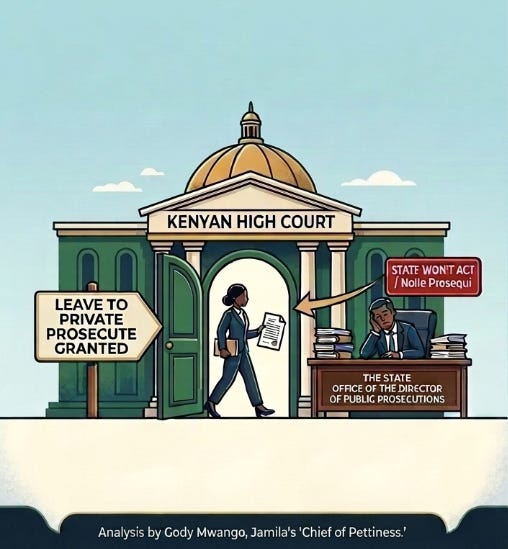
The facts were that when the applicant, Mariko Mustafa Wasike, went to answer a Chief’s summons, he left with injuries. The man who summoned him, Joseph Kaita, the area Chief, had physically assaulted him at the office. Wasike reported it, got treated at the hospital, and tried to do everything right. Then the system closed around him: The hospital where he was treated refused to sign his P3 form, a necessary document to initiate a criminal charge for assault. Wasike claimed that the Chief’s administrative reach influenced these actions. He notified the ODPP, but they too did nothing. Therefore, a government official allegedly used state machinery to render himself prosecution-proof. So Wasike went to the High Court and asked to prosecute Kaita himself.
In a brief ruling, the court not only said yes. It affirmed that an applicant could approach the court “by whatever means”. In addressing a dangerously vague law area that had been neglected for decades, the court noted that under Kenyan law, although the right to private prosecution exists in the Criminal Procedure Code, the route to exercising it was never codified. The only procedural guidance came from Kimani v Kahara [1983] eKLR, which suggested leave should be sought at the Magistrate’s Court once the accused appeared for plea. That placed the cart before the horse: how do you summon an accused to plead before a court has authorised your prosecution? The framework was circular, and for ordinary citizens facing powerful respondents, practically unusable.
For these reasons, the court was unequivocal that Kimani was decided under the 1969 Constitution. Contrarily, the 2010 Constitution abhorred procedural technicalities for substantive justice. Under Article 165(3), the High Court is vested with unlimited original criminal jurisdiction. The court reasoned that it was empowered to handle anything within the Magistrate’s mandate & could certainly grant leave for matters destined for that court. The Magistrate’s Court, as the court put it, “exists to assist the High Court discharge its mandate” [9].
For all its practical utility, the ruling falls short of resolving all questions. For instance, the ruling failed to clarify the test it applied in granting leave, be it draft charge sheet content assessment, standing, or sufficiency of evidence, given that the application was unopposed. Hopefully, a future contested case will allow the court to engage with these details robustly. Besides, the ruling does not clarify whether the Magistrate’s courts retain a concurrent leave-granting jurisdiction or whether the ruling transfers that function upward entirely. These are not trivial doctrinal gaps. On the whole, however, the ruling’s core holds that where prosecution is obstructed through state capture, private prosecution is not merely a legal procedure but an essential structural safeguard. Wasike v Kaita settles it that the High Court is the proper venue to trigger leave for private prosecution and that procedural technicality will not be used against an applicant- the door is wide open. For a man who visited a government office to answer a summons and was assaulted, this decision is not nothing.
©Gody Mwango (Advocate). The author practises at the intersection of constitutional and human rights law.